Language and Gender
The 3rd edition of Language and Gender was published in November 2019.
 Since its first publication in 1998, Mary Talbot’s Language and Gender has been a leading textbook, popular with students for its accessibility and with teachers for the range and depth it achieves in a single volume. This anticipated third edition has been thoroughly revised and updated for the era of #MeToo, genderqueer, Trump, and cyberhate.
The book is organized into three parts. An introductory section provides grounding in early ‘classic’ studies in the field. In the second section, Talbot examines language used by women and men in a variety of speech situations and genres. The last section considers the construction and performance of gender in discourse, reflecting the interest in mass media and popular culture found in recent research, as well as the preoccupation with social change that is central to Critical Discourse Analysis. Maintaining an emphasis on recent research, Talbot covers a range of approaches at an introductory level, lucidly presenting sometimes difficult and complex issues. Each chapter concludes with a list of recommended readings, enabling students to further their interests in various topics.
Language and Gender will continue to be an essential textbook for undergraduates and postgraduates in linguistics, sociolinguistics, cultural and media studies, gender studies and communication studies.
Published by Polity Press and available here. The first edition appeared as Language and Gender: An Introduction in 1998. An Arabic edition was published by Shahrayar Books, Iraq, in 2022 (translated by Mahmoud Ahmed). Huazhong Normal University Press, China, published a Simplified Chinese edition in 2004 (translated by Ai Xiaoming).
Critical acclaim for the 2nd edition (Polity, 2010)
“This new edition of an indispensible textbook provides a clear and engaging overview of foundational research and current trends in the interdisciplinary study of language, gender and sexuality. Theoretically informed and empirically grounded, this text will serve as an essential guide for new generations of students. It is also a valuable resources for researchers seeking to update themselves on recent developments in this dynamic field”.
Professor Mary Bucholtz, University of California
“Mary Talbot’s book provides a comprehensive, theoretically sophisticated and accessible introduction to the field of language and gender. Unlike other language and gender textbooks, Talbot foregrounds the importance of language and gender studies in the analysis of popular culture and mass media ‘texts’. Thus, Talbot’s book will appeal not only to students and scholars of linguistics, but to anyone with a serious interst in cultural studies”.
Professor Susan Ehrlich, York University, Toronto
“The author moves smoothly and coherently from more traditional approaches to language and gender through to very recent research in areas such as discourse and consumerism, and language, gender and sexuality. Different approaches, including Critical Discourse Analysis and social constructionism, are demonstrated, and difficult concepts are clearly and comprehensibly presented. Mary Talbot’s own research enriches and enlivens the discussion throughout. The text is extensively illustrated with interesting examples, many of which are taken form recent published research, thus introducing students to relevant and authentic material”.
Professor Janet Homes, Victoria University of Wellington
“I just wanted you to know that your book, though required, is one of the most inspiring books I’ve ever read. Your insights are revolutionary and I have greatly enjoyed reading them…I feel it is necessary to give respect where it
is due. So, thank you very much for providing a light of inspiration”.

Email from Amy, student in San Diego
“Without doubt the book will serve as an excellent textbook for upper undergraduate and postgraduate students”.
Discourse Studies
“The book is engagingly written and remains a key textbook for students and junior researchers in the field”.
Discourse and Communication
3rd edition Contents
PART 1 Airing Stereotypes and Early Models
1 Language and gender
About this book
Linguistic sex differentiation
Sex versus gender
Sex and gender as troublesome dichotomies
Further reading
2 Talking proper
Women, men and ‘standard’ English
Social stratification studies
Accounting for the differences
Some problems
Market forces and social networks
Gender signals
Sex, gender and voice quality
Further reading
3 ‘Women’s language’ and ‘man made language’
Early interest
Sexism
‘Women’s language’
‘Man made language’
Conclusion and lead-in to Part 2
Further reading
PART 2 Interaction Among Women and Men
4 Telling stories
Studying stories
Story content
A couple tell a story
At the family dinner table
Comparing two cultures
‘Father knows best’
Generalising from research findings
Further reading
5 Conversation
Conversation as a genre
The conversational division of labour
Miscommunication
Politeness
Men’s and women’s interactional styles
Equal but different?
Further reading
6 Difference-and-dominance and beyond
Deficit, dominance and difference
The trouble with ‘dominance’
The trouble with ‘difference’
The suppression of power
Overemphasis on miscommunication
Fake neutrality
The reification of gender as ‘difference’
Beyond difference: the influence of post-structuralism
Further reading
PART 3 Discourse and Gender: Construction and Performance
7 Critical perspectives on gender identity
Why critical?
Discourse and discourses
Discourse as social practice
Gender identity and subject positioning
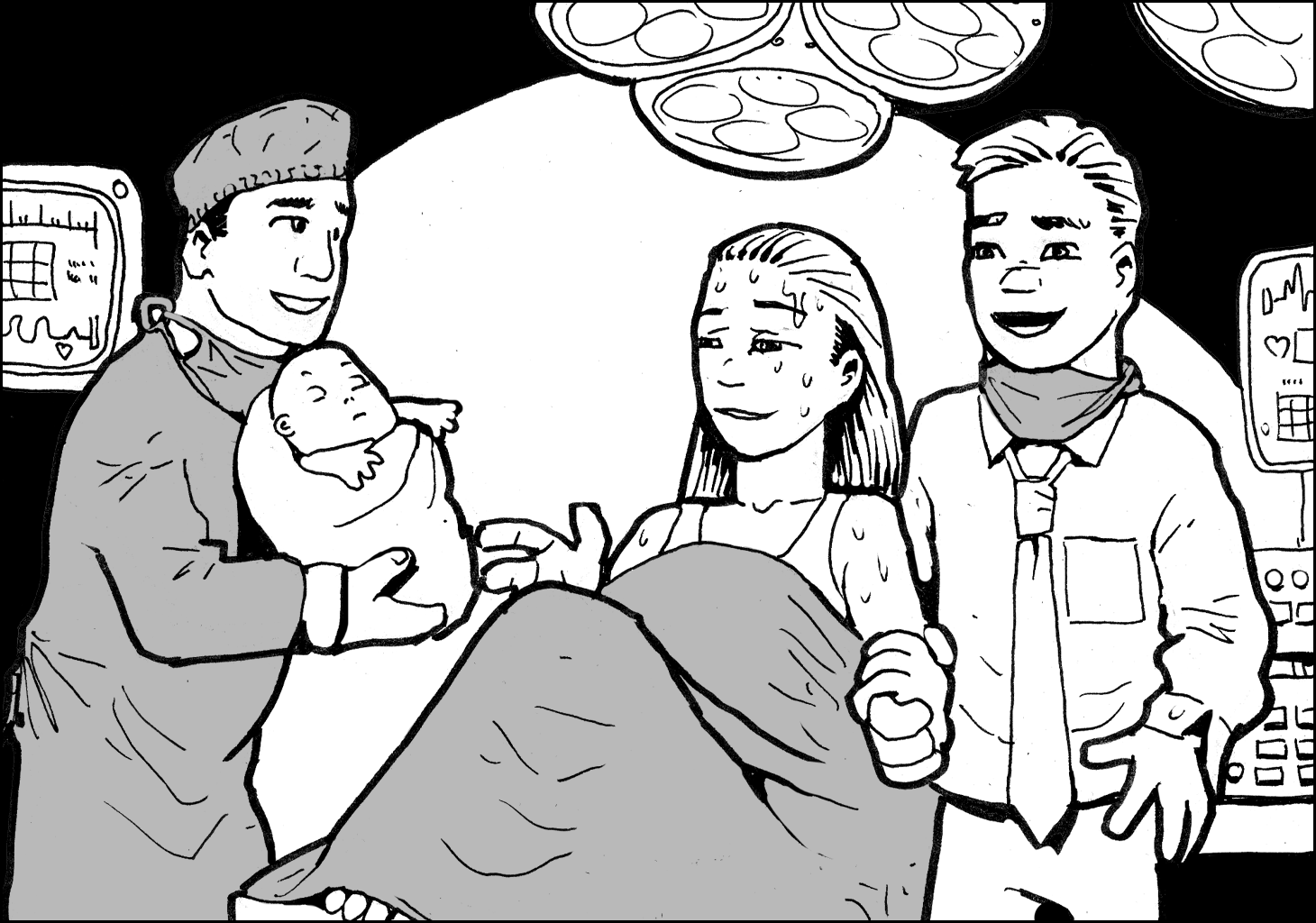
The discursive construction of maternity
Examining constructions of gender identity
Further reading
8 Consumerism
Femininity
Women and consumerism
Multiple voices in magazines
Power relations
Text population
The voice of a friend
Men as consumers
Further reading
9 New men and old boys
Masculinities
Dominance and control
A fraternity hierarchy
Representations
Men’s work
The importance of being hetero
The ‘antithesis of man’ among US college students
Real men in working-class Catalonia
‘Guilt over games boys play’
Change, resistance and resilience
Media containment
Masculinity under threat?
Further reading
10 Professionally speaking
Women and the public sphere
Politics
Broadcast interviews
Women in charge: dealing with the double-bind
Resistance and reprisal
Media representations of working women
Gendered cyberhate
Further reading
11 Language, gender and sexuality
Queering gender
Heteronormativity
The conversational backdrop: a clamorous heterosexuality
Homosociality among male university students
The sexual politics of consent
A Canadian tribunal case
Contestation and struggle in indigenous African communities
LGBTQ: Resisting heteronorms
Further reading
12 Reclaiming the language
Modes of struggle
Resistance and contestation
Struggles over access
Interventions
Counter-resistance
The media
Academia
The Phantom Menace
‘PC’: its use and origins
‘Political correctness must be crushed!’
Further reading

One Comment
Pingback: